
Continued reflections on my experience of being part of the Listening to the Unconscious workshop offered by GRI in November 2022
July to November 2022 was like no other four months I have lived. My experience and understanding of myself and my practice of group relations shifted. My finally posting this on this blog, gives me a sense that it has something to do with my ability to authorise myself. It has been supported in no small order by a recognition that I am a beneficiary of the love, grace, leadership of others!
This poem spoke to me many times during this period.
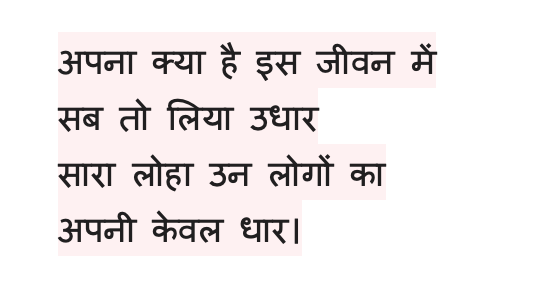
Full poem by Arun Kamal, here. Loosely translated it means –What is my own in this life, Everything is taken as a debt, All the metal belongs to these others, Mine is at best is the action at the edge.
Recruitment is the first step to creating the learning community that will be the workshop. GR workshops dont give answers – they help open questions for explorations. So to talk to someone about the workshop means tapping on tangible benefits one has experienced of GR work. This personal experience seems the strongest currency for recruitment. When recruitment efforts activated this experience in a system, it could result in someone expressing interest, but as significantly, this led to a past member acknowledging their own learning. When recruitment becomes unconsciously some kind token offering to show our allegiance to GR or an offering to the director, we may lose the potential of these recruitment conversations.
Plenaries have been spaces where, in my experience of myself as a consultant, I would wait a fair bit before offering something. Two things happened in this workshop. One, the task of the plenary got clearer to me – as sense making collectively, a place which is not just a village square of the workshop where learnings/insights/dilemmas/feelings are published. It is also a place where these are worked with in public and further exploration and collaboration is possible. Second, the role of director made the collective management role alive for me. If you see something, you say it in the most helpful way that is feasible at that time. So my earlier avoidance was an avoidance of my collective management role!
Talking of role, the GR idea of role is an action verb! You clarify your role by acting on it and each time you act you increase your own authorisation, leading to greater clarity! A dominoes effect almost! In working with colleagues before the ICS, I thought I set the boundary by setting the brief of the presentation. I did not engage with my colleague’s plan for the session for the first ICS. The experience showed that it was important to go through the presentation together. I struggled however to ask my other colleague who was doing the second ICS – to share and agree to the flow of the session. ‘System in the mind’ evoked for me was approval by a ‘senior’. I also had unworked with feelings with the colleague, which evoked guilt. I could not access the authority of my role and something that was needed for the task of that event. I finally found my role and he found his, quite close to the session. It was with the third ICS, when my colleague shared the presentation ahead of time, I found my role with respect to ICS. It is to be clear on the way the conceptual framework that is being offered as food for thought in that particular ICS. It is something that should be also discussed in the staff meeting. Seeing the PPT helps us all see how the ICS connects with the here and now of the workshop and be better prepared to complement with examples and ideas to strengthen the core ideas.
Experiencing one’s impact on the system, helps strengthen one’s intention to act with responsibility. It makes you want to get your shit together so that everyone can do the work that needs to be done! One staff gathering, I quickly debriefed on an open question from previous night, which pertained to RAAG and also an area where I had been challenged on the stance I had been taking. This was in a short break, just before my colleagues were to consult to SSGs. Seeing my colleagues rushing out to reach the workrooms in time, even as I was just finishing what I had say, I realised, what had I filled them up with? Could I have waited for a bit longer?
The staff room has always been a place of refuge for me in a workshop – a place to sit, think, reflect. I experienced this time the staff room as a place to connect. For me and those who were not consulting to events at that time, as a place for conversations – deeply personal, interpersonal but moving something for oneself and also for the system. We work with each other in the informal space – the staff room is that transition place between the interpersonal and the system.
My pre workshop dreams had recurrent themes around menstruation. Associations on these were with some sense of shame, staining and also whether I had it in me to do this work. The experience of the LTTUC was an experience of interdependence. How little one can do after one has brought the constituents of this workshop system together! At the same time, so much can be done when one stays in one’s role and trusts others to be in theirs. In one dream, I was wearing green pants, like surgeons wear, and one was not clear if the liquid on me was sweat or blood! I saw the GR traditions as the green giving a supportive fabric to do and to cope with the pursuit of experiential learning. An almost obsessive focus on members, idea of collective management, authorisations and accountability to the primary task to name a few. Also, the scaffolding that GRI as sponsor has put in place which allowed for new directorates to offer a good enough container for the work to happen!
Directing the LTTUC is among my biggest professional achievements. It was generative. A very gratifying experience of working with staff, members, venue, office, designers to create new experiences with and through group relations frameworks – something I have benefitted from so much. I have even deeper gratitude for the directors of events I have been part of, for their leadership. For anyone invested in working with GR frameworks, a director’s role is something to gear up for – as a way of giving back and to give to oneself and one’s practice.

 Thoughts. Insights. Action