
Life held too close to chest,
leaves gasping
for fresh breath,
Find in me
the courage for a reset
Feel freshness,
hold lightly, the silken threads
Trust in resilience
and destiny
Find wonder
Step outside
wander
…expression for learning
Life held too close to chest,
leaves gasping
for fresh breath,
Find in me
the courage for a reset
Feel freshness,
hold lightly, the silken threads
Trust in resilience
and destiny
Find wonder
Step outside
wander
Happy birthday they said. Thank you said I.
It’s my 45th today.
The cake is cut at midnight. The family video calls. Maybe it was the distance or the closeness. I said thank you to my parents and my sister for tolerating me all these years. For the first time, I felt grateful for their being vested in me all these years. My mom recalled how my sister would never hit me. mar doongi. She would say. Full show. But worrying about how it would land if she went ahead! It took me more than half of my life to see how that bracing back her anger- 3 years separating her from me – shaped her then. How her brace shaped me and my nothing can happen to me attitude.
My life has been about me, mostly. There has been space for an “and” at best. Person and me. Experience and me. Purpose and me.
Or is it experience for me. Purpose for me. The and becomes the for. And in the process, Me becomes the never growing up baby, that needs to be always fed and taken care of!
So today, I wish myself a happy birthday. Wish myself less self absorption. More grace. Less mirrors on my walls. More space in my room.
Time for the feast now.

Finding our victim voice is easier. No one likes to be a perpetrator. More so if you are in the development or aid sector. You start working for benefit of the other and gradually, unconsciously, begin to represent them. Their voices become illustrations in your stories. Their stories become case studies.
Reality is messy and multiple. The solidarity in struggles is real. The transformative stories of change are real. The echo becoming the voice is equally real.
Work in the social sector, for those of us from privileged sections of society, is not just about making the world a better place. It is about putting our privilege to work. Society works to keep caste invisible. It is upto each individual to accept their status as beneficiaries of this broken system. Lifting the veil over our own history brings shame and pain. Institutions have developed sophisticated ways to cope with these difficult feelings.
Think about this. Any PPT you have made, which is worth its slides contains photos of farmers, students, children and mothers. Their identity, often nameless, becomes an exhibit in an argument you need to make. You, a beneficiary of the system, are unconsciously appropriating identity of the oppressed, to make a point about their needs and how you are going to be helping them. In the process, there are usually benefits – additional funds may get allocated, enabling policies may be formulated. One may argue that there is no misuse, it is for greater benefit after all. But such representation is fitting their voice in your narrative.
How is this voice placed on platforms? As ‘voices from the field’. A space for being heard is created, which is then deliberated by ‘panelists’. This does contribute to new insights for those in the room and a new experience for those sharing their experiences. These voices also add to the increased credibility of the event as one that presents all perspectives. When was the last time you attended a conference organized by those from the community, where you were ‘voice from the field’ and panelists later talked in another language?
So, why are these boundaries so difficult to transcend?
Insights are “takeaways” – you can package them and take them back home. Transformation can’t be packaged. It is where exchange happens – emotional or intellectual. something shifts. By segregation of community representatives and ‘sectoral experts’, space for dialogue and opportunity for transformation is lost. Status quo is, unconsciously, maintained.
Does this imply that development efforts don’t change anything? Change happens. It happens in pockets, fabric of society remains lightly challenged, largely unchanged. Change happens in villages and in communities. It happens in another world , far from the offices of the development actors.
If a caste analysis was to be done on staff of philanthropies or nonprofits, we can expect to see the pyramid to be largely lower caste and female at the lower rungs, upper caste and male in leadership and power. This is in line with the trends in public institutions. Three out of four anchors of flagship debates on television are upper caste. No more than 5 percent of all articles in English newspapers are written by Dalits or adivasis. A study of a digital inclusion project showed that content creators were rarely from the Adivasi community.
‘But I work for others, the marginalised’. This used to be a solace for me, to explain my own personal stand in this unequal world. 2020 has revealed how structural inequality is unconsciously hidden, often behind good intentions. I now examine my intention. Am I here to create a legacy? Am I here to put my privileges to work? To be a change agent, I need to actively seek out and embrace the discomfort that transformational spaces bring.
“naach na aaye angan tedha” – an old Indian adage. Don’t blame the stage, if you don’t know how to dance. It captures the deeply feudal or fatalistic thinking of India. It puts individual capacity above a broken system. The stage cannot change, dancer should kindly adjust and learn to dance on slippery slope. A development sector professional who has accepted their own status as beneficiaries of this broken system, will begin to see more spaces for drawing attention to the slope, not just the dance. Baggage of one’s own caste and class privilege must be unbundled and explored on the road less travelled.
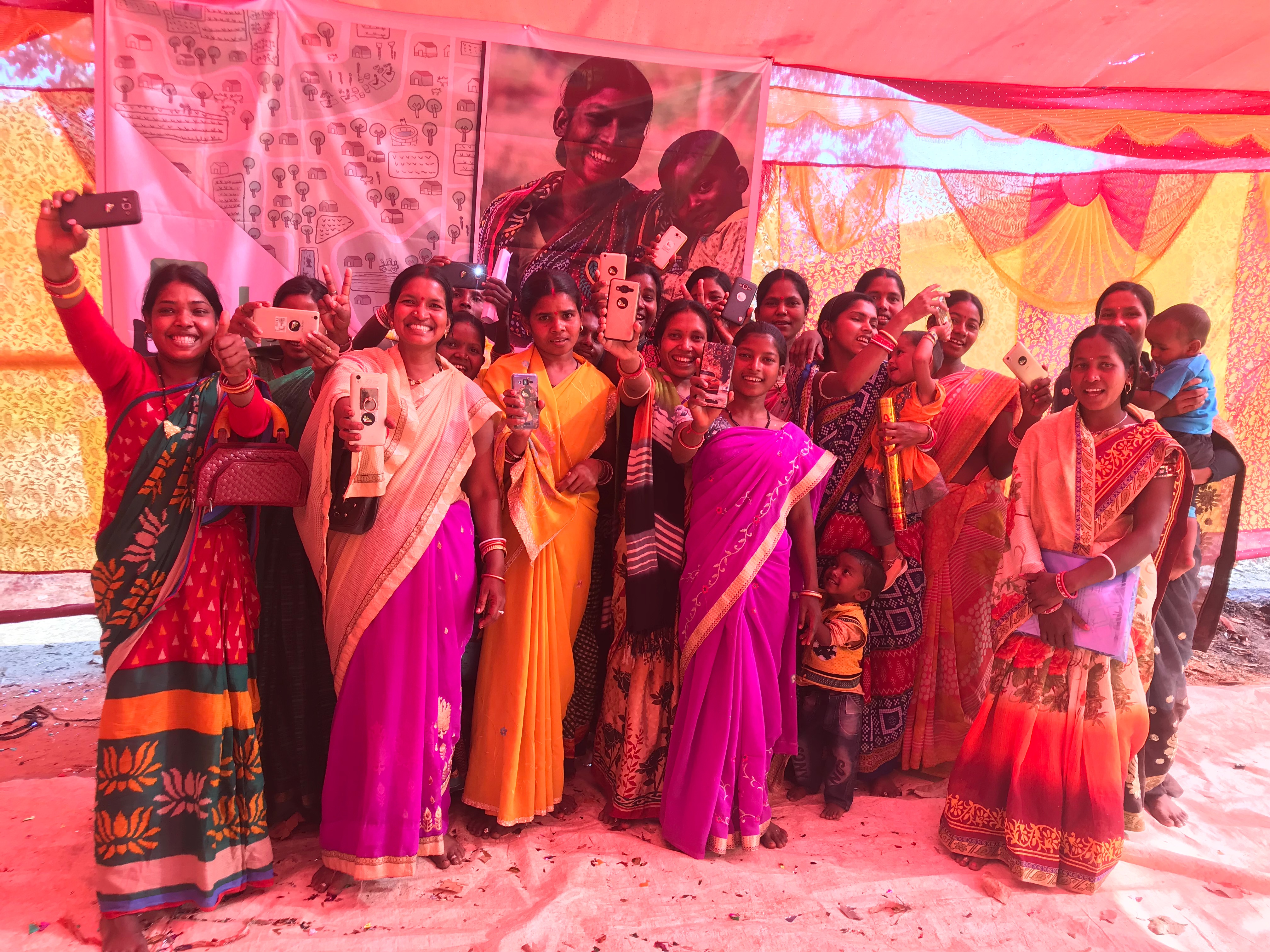
It’s real now. An idea intent on happening.
First seed in August 2014 of a digital platform that presents curated information to smallholder farmers. Intent and initial exploration in March 2015, with phone to our first vlogger. Sketch in mind and of commitment September 2015 to focus on agriculture and some infotainment. Research, writing and sharing December 2016 as part of the Chevening Gurkul Fellowship… First concept test Jan 2016.


Testing and more refinement through the year…. and here it is now.
I am Kisan creates a digital platform where curated information is available to smallholder farmers in building their self-reliance and resilience. Starting with agriculture, it helps the user community i.e. smallholder women farmers in being less dependent on their immediate context for information and services. Built on Android, the application has been built in English, Hindi and Oriya and is targeted at farmers in the specific geographical context of the Central Indian tribal belt.
Through this period I felt almost embarrassed apologetic about working on a mobile app. As a totally brick and mortar believer, and with focus on an area like the tribal belt, surely what can a mobile app achieve? What and how much can information really achieve? Where are the phones? While these questions still linger just an inch below the surface of the login screen in my mind, this journey has increased my conviction of the interest of these farmers, who are in early stages of prosperity, in seeking knowledge, connect and voice. Some assumptions have been reversed and some new insights generated.
Smart phones. People are on the cusp of decision making on smart phones – good content and mobilisation can drive up purchase/ conversion into smart phones. In the place where online and offline worlds, these changes are supported and triggered by a larger eco system. I get onto a platform when I am likely to find more of mine besides the new. Here too, while its quite an individual choice, it is also systemic.
Interest in something new- patience and interest in getting this application … as a doorway almost for this new world is immense. There is willingness to work through hiccups to get something new. New is what has helped us get a start and new is what will need to be retained for delivering value.
We asked a question as part of our baseline – how far does your good work carry? How far would you like it to go? Digital technology has the possibility to amplify the voice of these farmers. Videos uploaded to our beta release have got increasing views, giving us confidence that this a powerful medium for expression and learning.
When we started design process, internet connectivity was a big issue. We designed the app as totally offline. Today of the users, 80% are on the internet already. It will take good content to keep them online, supported of course both my affordability and ability to buy. Almost as a reminder of the reality of the region, our efforts to get our 100th user saw us on the rooftop of a village looking for range to do an offline install of the application…We need to cater to both worlds in the design.
In a world of million downloads, 100 is a tiny speck. Sitting in the greenfield “real estate of the mind” of these first time 100 smartphone 100, is an exciting place to be! Now to making this a township! We plan to sit with users regularly to ideate, create buzz and refine…. because knowing is the only way to stay new.
I want to work in accelerating the process of change and transformation where there has been deep impact and there is mandate for more. Changing the “things as usual” attitude that tends to develop and help move more purposively with greater clarity of task. I have experienced that among other things, strategic communication can play this role in this journey.
First, as everyone looks for a tagline/catchy phrase, it gives an opportunity to sharpen the focus on the goal of the program in a creative process. In a program that I anchored we always talked about integration of multiple interventions at household level. It became much more real with a program goal being Lakhpati Kisan – just the change in phrase captured the thinking of the program and its focus. It helps to rally all efforts in one inspiring output. Of course, it is the beginning. Just name changing by itself doesn’t do much. In a larger environment of tokenism, what brings the ‘aha’ is the process by which you come to this clarion call. It means thinking together with attention to our shared vocabulary and the emotions behind the words. It means taking stock of where we are, where we want to go and challenges that we see in the process.
Most development sector stories are more about the larger message – the organization, the promoter, the donor, the bigger message – weaving the stories of impact at the community level to make their point. Which brings me to my second point on how communication can play a critical role in accelerating change. If you believe that people are fundamentally enterprising and willing to take charge, then communication done in a way that talks to them and their concerns can be very powerful in that translation from intent to action. Community to community sharing of experiences is a long tried and tested tool for effective extension and motivation. With film and communication products, this gets another dimension. You are not just putting a story out, you are putting forward a possibility. Communication that captures the human story – not just the technicality of the intervention – can deeply inspire and trigger action.
A canvas for this got created when a women’s federation with an inspiring history wished to capture their story. Thus came about the film – No Small Change – stories of women who stand tall. Narender, Neelanjana and I over a few sessions of brainstorming identified what was unique about their story. As happens with great work, this was a good statement about also what was sectorally very relevant. Enterprise, Housing, Vulnerability. The shoot followed soon. In the process I realized how much it was really friendships that had helped these women – giving support to each other when they were broken, as much emotional as financial. They built these friendships as they worked together in cluster associations and the federation.
While the full film is not on youtube as yet, here is the one made on enterprise…
It was a result of our friendship too. We hope to capture many more such stories. For us too, the journey has just begun.
India Philanthropic report 2017 brings focus on the individual donor. The 150,000 odd households that today are investing about Rs 36,000 crores towards philanthropy in our country. More than all the CSR put together. While the report delves on the market segmentation from the investor philanthropist point of view, it would be good to take a step back and see the bigger picture. What kind of investments really bring change, irreversibly? Continue reading “New age philanthropy : delivering new age impact?”
 Thoughts. Insights. Action